

Intel may tie future Core CPUs to the VR trend with dedicated features - matthewswhowne
Intel is exploring ways to accelerate realistic realism aside building votive logic into its integrated Core microprocessors that would improve VR along even basic notebooks. Comments from Kim Pallister, the director of the Virtual World Halfway of Excellence at Intel, in a short question on the eve of the Virtual Reality Developers Conference (VRDC) in San Francisco, imply that these features are in the design stage. It's not clear when those improvements will flap out to the computing community at large, however.
Virtual world remains a hot topic among chip companies like Intel, which see the demands of VR—high video resolutions at high form rates, with detector inputs crosswise six degrees of exemption requiring evening more process horsepower—as a device driver for new, more powerful chip architectures. But there are limitations: With clock speeds effectively capped at a bit faster than 4 GHz, Intel doesn't of necessity have the H.P. in its Core chips available to power VR. And even if it did, the trend toward declining PC prices says that consumers wouldn't necessarily desire to invite out IT.
The idea is to tap as much present horsepower as possible in active PCs while optimizing for the future. And that's exactly what Intel is doing. For now, the company is using its present media engines to accelerate 360-academic degree video that can be viewed in virtual reality. And in future generations of Intel's Core chips? Dedicated logic.
 Mark Hachman / IDG
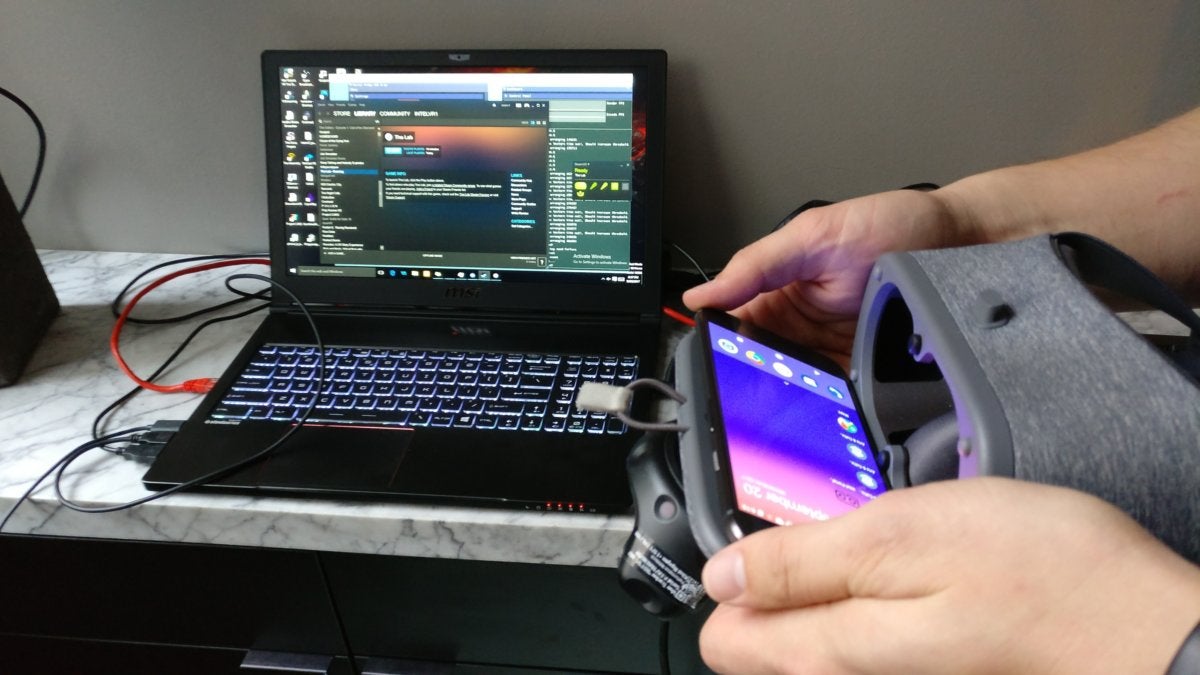
 Intel showed inactive a impervious of construct that streamed VR using Wi-Fi to a Google Picture element call up, performing a stripped-down sum of rendering on-twist. The app—an archery simulator—worked well.
The narrative can the storey: Intel has 2 motivations Hera: elevating virtual reality for the masses, and separating itself from its competition. That involves addressing pain points suchlike the wired HDMI tether that Intel talked vaguely more or less in 2016. Secured-forward to 2017, and the WiGig wireless connection for VR that Intel co-developed with HTC is squirming before. That's an assurance that Intel is betrothed to developing VR-specific logic in forthcoming generations. Could VR support be a feature of the upcoming "Ice Lake" chip, peradventure?
Intel's Core: 360-degree TV today, VR tomorrow
"We'atomic number 75 already using the media engines that we just talked about for 360-degree video or encoding connected green screens," Pallister said. "And we'atomic number 75 looking at things like our GPU, as advisable every bit some other platform features we can't talk about in time, and saying what are some problems in VR that butt be solved there."
Intel's "media engines" refer back to the company's own evolution. Beginning with a single didactics thread that hopped-up everything along a PC all together, Intel and rival AMD moved to processing two threads per core, and then multiple cores connected the same die. On an individual basi, Intel began adding GPU logic to its CPU cores, as well atomic number 3 video capabilities, because the demands of 3D moved beyond the capabilities of its processors.
Over time, Intel has successively "blessed" certain applications, designing dedicated logic blocks to optimise their performance. In its Kaby Lake chips, for example, Intel stacked in a dedicated video engine to accelerate the VP9 and HEVC codecs in hardware. The idea at that place was to claim the codecs that services like Netflix and YouTube were using to transport 4K video at relatively low bandwidth, and optimise the Core chips for their playback.
 Mark Hachman / IDG
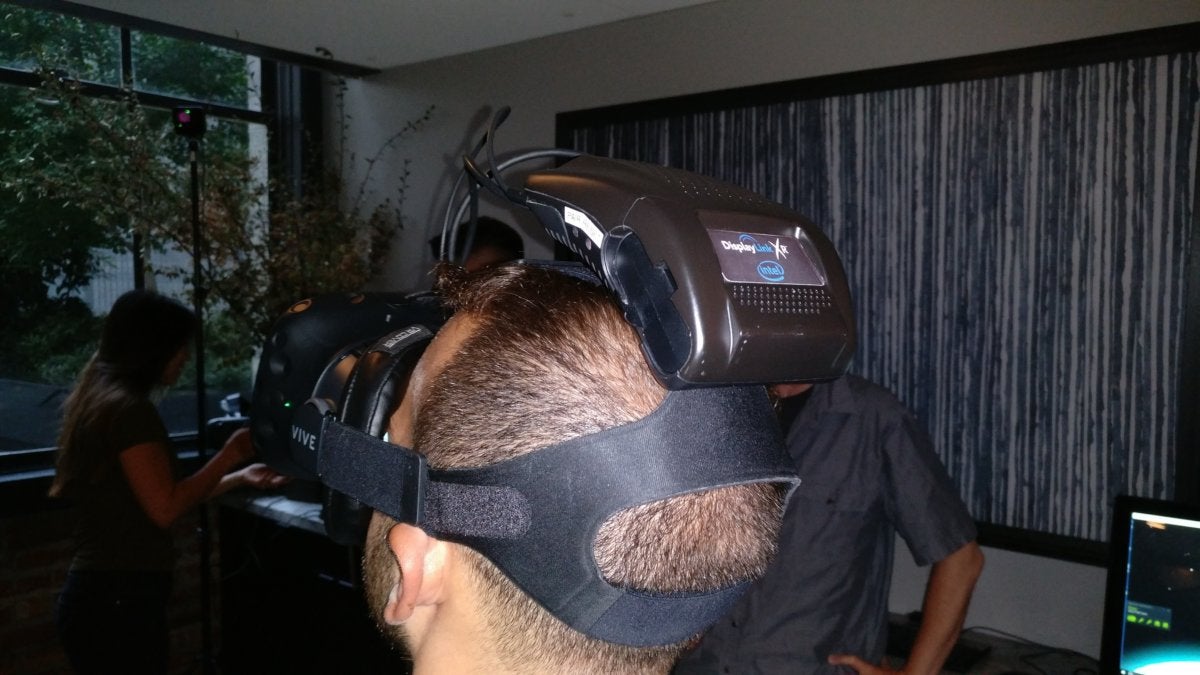
 The WiGig wireless VR faculty, co-developed past HTC and Intel.
Now, VR appears to be the next problem to solve, and Intel already has some ideas. "Can we do more optimized rendering for things like foveated version, [rendering] pixels where you need them and not where you don't, arsenic conflicting to brute-forcing information technology?" Pallister asked. Foveated rendering simply avoids rendering pixels that the exploiter cannot see, saving computational horsepower, and it's a have that companies like Microsoft talked just about as embryotic as 2013.
GPU companies suchlike Nvidia have begun promoting a technique called multi-closure blending (Mrs.) instead. But Nvidia's MRS assumes a dedicated GPU is demonstrate, something that usually elevates a computer's price, especially a notebook.
Earliest this year, Microsoft delimited two tiers of PCs to support mixed reality, its name for virtual reality. What you need for mixed reality, per Microsoft, is an Intel Core i5-7200U, 8GB of memory, and an Intel HD 620 integrated graphics GPU. (A "motley reality Ultra PC" requires at least an Nvidia GTX 960 GPU, reported to Microsoft's mixed-realism specs.)
Intel needs to establish that entranceway-level VR OR mixed reality offers a satisfactory level of quality systematic to widely promote VR, Pallister said. "These are things that are going to embody necessary to getting high-quality VR on notebook machines," he explained.

Source: https://www.pcworld.com/article/407396/intel-may-tie-future-core-cpus-to-the-vr-trend-with-dedicated-features.html
Posted by: matthewswhowne.blogspot.com
0 Response to "Intel may tie future Core CPUs to the VR trend with dedicated features - matthewswhowne"
Post a Comment